Where to Find Free AI Prompts in 2026: 7 Sources Compared
Official prompt packs, open-source libraries and community sites, and which one fits the job in front of you
You don't have to pay for good prompts. Here are seven free sources, from OpenAI's and Google's own prompt galleries to open-source libraries, with what each is best for and what you're allowed to do with what you find.

Talha Riaz
Founder, PromptStore
The short answer: the best free AI prompts come from three kinds of places — the AI companies' own prompt galleries (OpenAI, Google and Anthropic all publish them), large open libraries such as prompts.chat, and searchable prompt sites like PromptStore and PromptHero. Which one to use depends on the model you're prompting and whether you need to reuse the text in your own product.
This guide compares seven free sources as of October 2026, explains what each is good for, and covers the part most lists skip: what you're actually allowed to do with a prompt you didn't write.
Key takeaways
- Start with the vendor. OpenAI Academy's Prompt Packs, Google's Gemini prompt gallery and Anthropic's Claude Code prompt library are free and written by the people who built the models.
- For reusable text, check the license. prompts.chat dedicates its prompt data to the public domain (CC0). Most other sites license prompts to you without giving you ownership.
- Match the prompt to the model. Image prompts especially are model-specific; a prompt tuned for Midjourney will rarely behave the same in Flux.
- "Free" sometimes means "free account." Some libraries are open to read; others ask you to sign in before showing the full text.
- Test before you trust. Run any prompt on a real example of your own work before you build a workflow around it.
What is a free AI prompt?
A free AI prompt is a ready-written instruction for a model like ChatGPT, Claude, Gemini or Midjourney that someone has published at no cost for others to copy and adapt. Good ones are specific: they name the task, the input, the format of the output and the constraints, so the model has less to guess.
The 7 best places to find free AI prompts, compared
| Source | Best for | Cost | Sign-up to read | Reuse terms |
|---|---|---|---|---|
| PromptStore | Browsing by model and category, text and image | Free prompts are free | Free account to reveal full text | Licensed for your use; creators keep ownership |
| prompts.chat | ChatGPT-style role prompts | Free | No | Prompt data dedicated to the public domain (CC0) |
| OpenAI Academy Prompt Packs | ChatGPT at work, by role | Free | No | OpenAI's terms |
| Google Gemini prompt gallery | Gemini API and AI Studio ideas | Free | No | Google's terms |
| Claude Code prompt library | Coding with Claude Code | Free | No | Anthropic's terms |
| PromptBase free prompts | Image and writing prompts from a paid marketplace's free shelf | Free section of a paid marketplace | Check the site | PromptBase's terms |
| PromptHero | Searching image and video prompts with example outputs | Free to search | Check the site | PromptHero's terms |
1. PromptStore — a searchable library you can filter by model
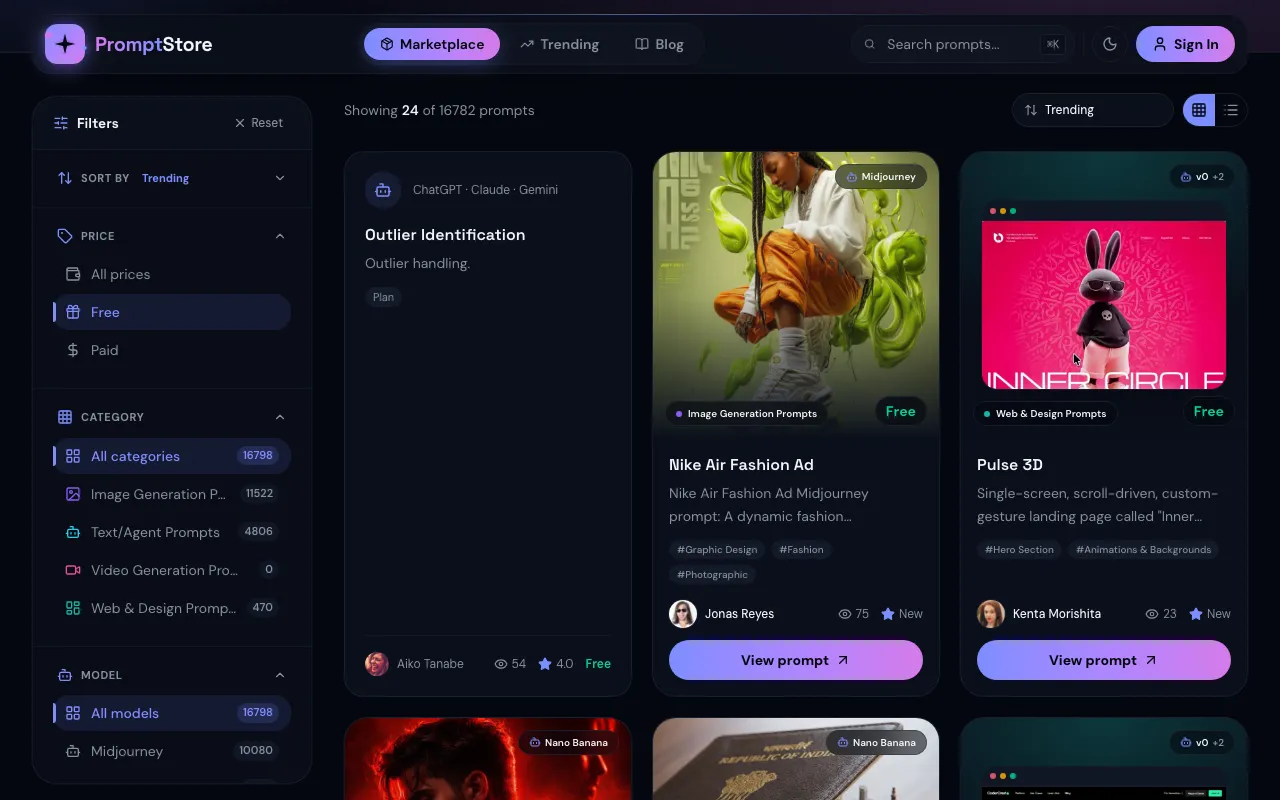
PromptStore is a prompt library where you can browse, search and filter prompts by category, AI model and subcategory, and limit results to free prompts only. Free prompts need a free account with a verified email: once you're signed in, the full text is revealed, added to the Library tab of your dashboard, and copied to your clipboard with one click. There's no payment step for free prompts.
It covers both text and image work. The text and agent prompts section includes business tasks like writing SLOs and SLIs, and the image generation section covers Midjourney, Flux and other image models. Prompt pages list the models a prompt was written for, which matters more than most people expect (see below).
2. prompts.chat — the big open-source library
prompts.chat, formerly known as Awesome ChatGPT Prompts, is one of the best-known open prompt collections on GitHub. Its license is unusually clear: the prompt content and data are dedicated to the public domain under CC0 1.0, while the site's code is MIT-licensed. If you need prompt text you can reuse in your own product or course without asking anyone, this is the safest source on this list.
Its strength is role prompts ("act as a…") for chat models. It is lighter on image prompts.
3. OpenAI Academy Prompt Packs — official prompts for ChatGPT at work
OpenAI Academy publishes free Prompt Packs: collections of example prompts grouped by role and use case, such as a Small Business pack offered as a PDF. If you use ChatGPT for work and want examples written by the company that makes it, start here.
4. Google's Gemini prompt gallery — ideas for the Gemini API
Google's prompt gallery collects example prompts for the Gemini API that you can open in Google AI Studio. It leans toward developers — examples include extracting structured JSON and working with audio and video — so it's most useful if you're building something with Gemini rather than chatting with it. Google's prompting strategies guide explains the techniques behind them.
5. Claude Code prompt library — for developers using Claude
Anthropic's Claude Code prompt library is a set of prompts to paste into Claude Code, collected from Anthropic's own guides. They're short and practical, like asking it to explain why a build is failing.
One thing to know: older guides link to a general "Claude prompt library" in Anthropic's documentation. As of October 2026 that address redirects to Anthropic's prompting best practices page instead, so if you're following an older list, that's why the library seems to have vanished.
6. PromptBase free prompts — the free shelf of a paid marketplace
PromptBase is primarily a marketplace for paid prompts, but it runs a free prompts section that describes itself as holding more than 4,500 free prompts for art, writing and video (as of October 2026). It's worth browsing for image styles, with the caveat that the site is built around selling, so expect paid listings alongside the free ones.
7. PromptHero — search image prompts by their results
PromptHero is a search engine for prompts for image and video models such as Midjourney and Stable Diffusion. Its advantage is that you search outputs: you find an image you like and see the prompt behind it, which is often faster than reading prompt text cold.
How do you tell a good free prompt from a bad one?
A good prompt is specific enough that two people using it get similar results. Before you use one, check for:
- A defined task. "Write a cold email" is weak. "Write a 120-word cold email to a VP of Operations at a US logistics company, offering a 15-minute call" is strong.
- Placeholders for your input. Good prompts mark what you replace, such as
[product]or[audience], instead of hard-coding someone else's example. - An output format. A table, a bulleted list, JSON, a word count. Prompts that specify the shape of the answer need less editing.
- Constraints. Tone, reading level, what to leave out.
- The model it was written for. If the page doesn't say, assume you'll need to adapt it.
Why does a prompt work on one model and fail on another?
Because models read instructions differently. The gap is largest for image prompts:
Midjourney uses its own parameters (like --ar for aspect ratio), and other image models
either ignore them or treat them as words. Text prompts transfer better between ChatGPT,
Claude and Gemini, but each vendor publishes its own guidance, and prompts tuned to one
model's habits can come out longer, shorter or more formal on another.
The fix is simple: when you find a prompt you like, filter for your model first. On PromptStore, prompts are tagged with the AI models they were written for, and the marketplace filters let you show only prompts for the model you use.
Can you use free AI prompts for commercial work?
Sometimes, and it depends entirely on the source. "Free to read" is not the same as "free to republish":
- Public domain (CC0): prompts.chat's prompt data can be reused, modified and republished without permission.
- Licensed use: most other sites, PromptStore included, let you use a prompt in your own work, while the creator keeps ownership of the text. Using a prompt to draft your own emails is fine; copying a site's prompts into a collection you sell is not.
- Vendor examples: OpenAI, Google and Anthropic publish their examples so people use them. Using them in your own work is the point; republishing them wholesale is a different matter, so read their terms first.
What about the outputs? In the US, the Copyright Office's position is that copyright requires human authorship, and its January 29, 2025 report, Copyright and Artificial Intelligence, Part 2: Copyrightability, addresses AI-generated material directly. This isn't legal advice; if prompts or their outputs are central to a product you're selling, talk to an attorney.
How to find a free prompt on PromptStore, step by step
- Open the marketplace.
- Pick a category, such as Text Agent Prompts or Image Generation.
- Filter by your AI model and set the price filter to Free.
- Sort by Trending or Top rated to see what others are using.
- Open a prompt and read its description and any example images.
- Sign in or create a free account. Your email has to be verified before you can log in.
- Select Copy to unlock the prompt. The full text is revealed and copied to your clipboard. It also stays in the Library tab of your dashboard so you can copy it again later.
Troubleshooting
The prompt text is blurred. You're not signed in. Free prompts on PromptStore reveal their full text after you sign in with a free account.
I signed up but can't log in. Check your inbox (and spam folder) for the verification email; accounts have to be verified before the first login.
The result looks nothing like the example. Check the model and version the prompt was written for, and replace every placeholder with your own details. Example images were produced with specific settings that a copied prompt won't always carry.
A list I'm following links to a page that no longer exists. Prompt libraries move. Anthropic's older prompt library address, for example, now redirects to its prompting guide. Search the vendor's current docs rather than relying on an old link.
Summary
For ChatGPT at work, start with OpenAI Academy's Prompt Packs. For Gemini or Claude Code development, use Google's prompt gallery or Anthropic's Claude Code library. For text you can reuse anywhere, use prompts.chat and its CC0 license. For image prompts, search by result on PromptHero. And for a single library you can filter by model, category and price, browse the free prompts on PromptStore.
If you've written prompts others would find useful, see our guide to selling AI prompts for an honest look at what that market pays.
Frequently asked questions
Often, yes. The vendors' own prompt packs and the large open libraries are free, and a prompt's quality depends on how specific it is, not on its price. Test any prompt on your own input before relying on it.